Overview
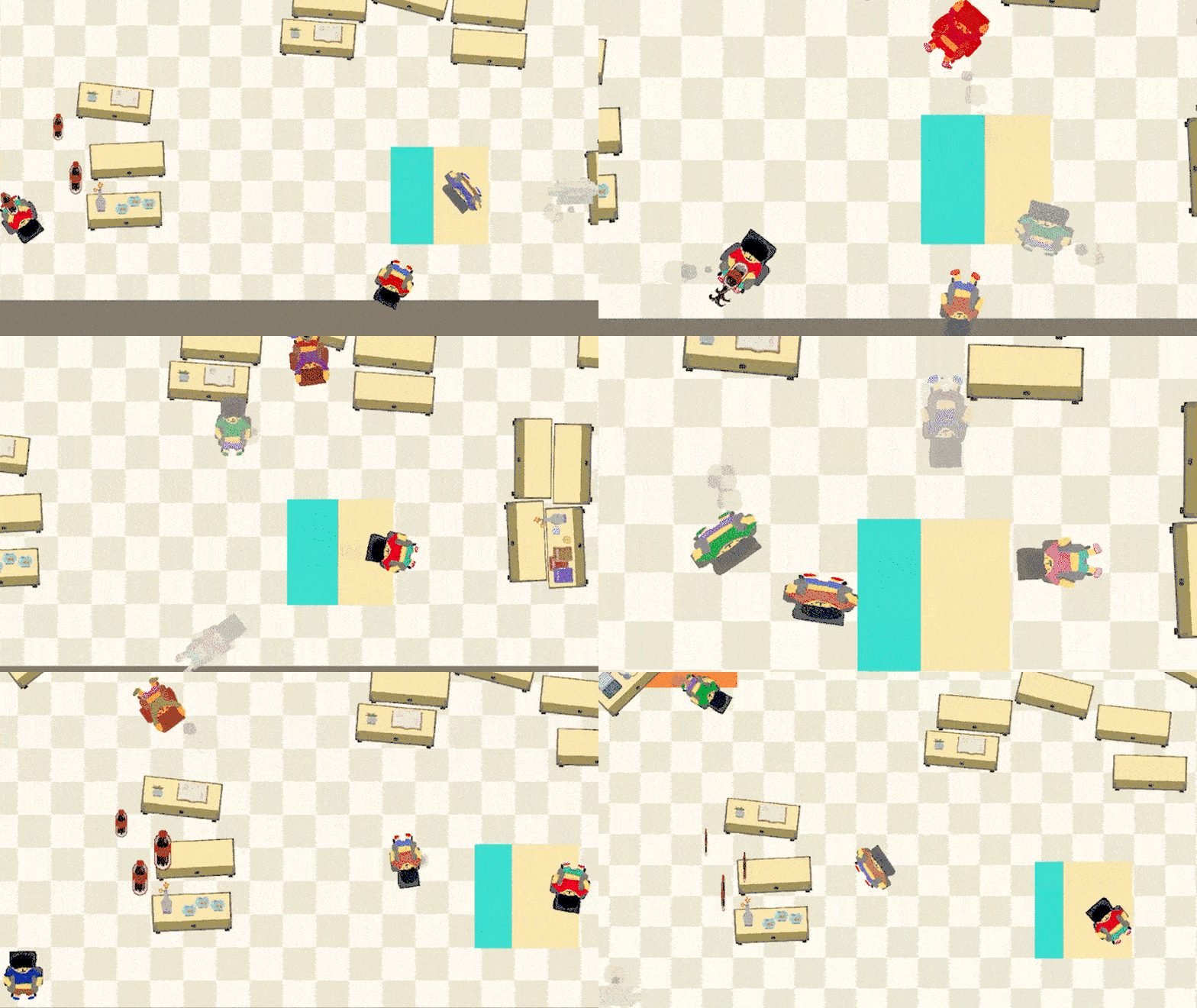
Super Chair Riders is a 4-player local multiplayer brawler completed by a team of 4 in Fall 2025. Players ride office chairs as unpaid interns, navigating a classroom-themed map through wall-kick propulsion, melee kicks, with area occupation as the win condition. The game is structured in two phases: a 4-minute Collect Phase for picking up ability items, followed by a Sudden Death phase where the map continuously shrinks and carried items carry over. I was responsible for game mechanic design and the implementation of the weapon and item systems.
Image
Problems Addressed
- Local multiplayer readability: Four players share one screen, so state feedback and visual differentiation must remain clear in chaotic fights.
- Physics-based movement feel: Chair movement uses impulses instead of direct translation, requiring careful tuning for both weight and control.
- Wall Scoot detection: Kick direction and wall collision detection must stay accurate across different movement speeds.
- Tools carry penalty: Carrying more tools lowers movement speed, so risk-reward tuning must feel meaningful but fair.
- Phase transition reliability: Item persistence and map-shrink logic must transition cleanly from Collect Phase to Sudden Death.
Solution & Implementation
- Scoot charge system: Movement force is applied as a single impulse; charge duration maps to a capped force and direction locks on release.
- Directional lerp smoothing: Facing interpolation speed is inversely proportional to current velocity, creating snappy idle turns and heavier high-speed turns.
- Wall Scoot collision logic: A dedicated kick hitbox applies a force multiplier when contacting walls/stage geometry.
- Weapon & item system: Pickup items provide distinct mobility/combat modifiers and persist through phase transitions.
- Visual state feedback: Character tint and sweat particle density encode mail load without relying on numeric UI.
Tech Stack
- Engine: Unity (2D + Physics 2D)
- Language: C#
- Input: Unity Input System (keyboard/mouse + gamepad)
- VFX: Unity Particle System
Key Features
- Scoot charge propulsion + Wall Scoot force multiplier
- Speed-relative directional lerp system
- Weapon and item pickups with cross-phase persistence
- 4-player single-screen play with color-differentiated sprites + status UI
- Two-phase flow (Collect Phase → Sudden Death)
- Shrinking map boundary + area occupation win condition
- Taunt system with Animal Crossing-style voice effects
Challenges & Tradeoffs
- Single-screen readability: Unified fullscreen camera simplifies implementation but increases requirements for character/UI clarity.
- Force-cap tuning: Charge and wall-kick force caps required repeated tuning to avoid out-of-bounds launches or clipping.
- Cross-phase persistence: Carrying item state from Collect Phase into Sudden Death was the main technical risk.
Results & Impact
The project delivered a playable 4-player prototype for the course demo, including the full two-phase loop and visual feedback system. The core design evolved from racing to area-occupation combat, significantly increasing player interaction density.
Next Steps
- Expand the item pool with more differentiated abilities to deepen strategy during the Collect Phase.
- Improve single-screen readability through character outlines and HUD layout refinement.